The Cost of Learning Piano: App Subscriptions (Like Talented) vs. Traditional Routes
Introduction To Modern Ways Of Learning Piano In The Digital Age
Wherever technology reaches today, learning to play the piano is no longer a luxury reserved to the elite few. The new formats of training opened by the digital era are where traditional methods merge with innovative solutions. Where once the lesson with a teacher was almost the only path, today mobile applications offer another experience: interactive, accessible, and flexible. For readers weighing learning cost, an app subscription in the Talented app versus traditional lesson pricing calls for a clear budget comparison — explore here.
Learning with gadgets is gaining momentum: enormous databases of lessons, the opportunity to practice anywhere and at any time, personalized tracks, and immediate feedback — only a few advantages. One question remains, though: will they be able to replace a live teacher? What are the pros and cons of each approach? Further in the article, we analyze:
- Traditional teaching methods.
- Overview of modern subscription applications and the functionalities provided.
- Cost and effectiveness of each option.
Our application was created, taking as the basis the needs and wishes of the modern student who appreciates time and quality. But to understand why the digital path is becoming more attractive, let’s take a look at established learning methods.
Traditional Method Overview Lessons With A Teacher And Music Schools
Lessons with a teacher are classic and time-tested. They guarantee:
- Individual approach and correction of technique.
- Immediate feedback and motivation.
- Development of the musical ear and giving the right base.
Lessons usually happen once or twice a week and require clear discipline and a schedule. Such training in music schools and with private teachers is important: the curriculum is structured, including solfeggio, music theory, and concert practice. It is impossible to overestimate live communication — it forms not only skills but also an emotional connection to art.
Traditional learning is associated with significant expenses of all kinds: financial and temporal. Traveling to lessons, fixed schedule, limited hours a week — all of this may seriously stand in the way of regular practice. Further on, a comparative table of the main characteristics of lessons with a teacher is given:
| Parameter | Characteristic |
| Frequency of lessons | 1–2 times a week |
| Cost | Medium to high, depending on region and teacher’s qualification |
| Schedule flexibility | Limited |
| Individual approach | Maximum |
Good is the traditional path when strong inner motivation and a possibility to regularly attend a teacher exist. But how accessible and convenient is it for modern users who live in the rhythm of the digital age? The next section is dedicated to the consideration of the alternative — subscription applications.
Subscription Apps For Piano Playing What Talented And Its Analogues Offer
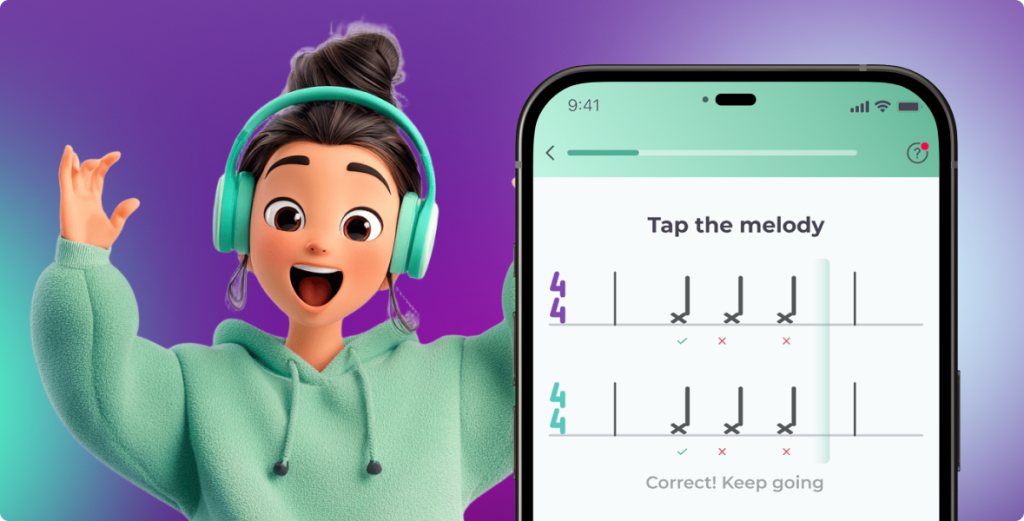
Digital technologies have, within the last years, enabled a real breakthrough in piano learning. Among popular solutions, subscription apps are outstanding, like Talented, Simply Piano, Flowkey, Yousician, and many others. Their main advantage is accessibility and the possibility to practice at any convenient time, independent of a teacher’s schedule and the facilities of a music school.
What can then be expected by subscribing to such a service? First and foremost:
- A wide range of interactive lessons: from the most basic exercises to complex compositions, adapted for different skill levels.
- Built-in listening and performance analysis: using sound recognition technology, these apps are able to track the errors in real time, often training the ear and sense of rhythm.
- Gamification of the learning process: achievements, points, daily tasks, and motivational reminders encourage regular practice.
- Accessibility: this will enable users to work on a tablet, smartphone, or computer. Thus, no special equipment is required other than the instrument in question.
- A huge library of literature and genres: from classical to jazz and even pop; there will be something to everyone’s taste.
However, most of the applications are designed for self-learning, with limited live interaction. Most of them offer additional services, such as online consultations with teachers, but less frequently and often require extra payment. For many beginners, this app subscription path is a strong entry point before committing to higher lesson pricing.
Comparative Cost Analysis Subscriptions Vs Individual Lessons
Another significant factor influencing people’s choice of learning method is the cost of education. Now, let’s see how subscriptions to apps compare with traditional lessons.
Subscription apps
- It ranges from 300 to 800 rubles per month.
- Commonly, one will find a free trial period available from 7 to 30 days.
- The annual subscription is from 3,000 to 7,000 rubles, which is notably cheaper than with a private teacher.
- No extra expenses are required to cover transportation and venue costs.
Individual lessons with a teacher
- The average price per 45–60 minute lesson — ranges from 800 to 2,500 rubles, depending on the region and teacher’s qualifications.
- With ordinary practice, say 4 lessons in a month, it can range from 3,200 to 10,000 rubles. Music school fees or other organizational charges may be extra.
- This often means wasted time to travel to where the lesson will be held, as well as money invested.
Learning Quality And Effectiveness Digital Approach Vs Live Teacher
When choosing the method of learning to play the piano, the quality of material absorption and overall session effectiveness become important criteria. We will compare key aspects of learning digitally through apps versus traditional lessons taken one-on-one with a teacher.
Personalization And Adaptation To The Student
- Reacting immediately upon mistakes and student’s peculiarities, a live teacher is capable of choosing exercises and explanations on the current needs and level.
- A standard course structured for a broad audience, apps more often offer, despite the presence of adaptive algorithms. But such adaptation usually relies on task completion statistics, not on nuances of emotional perception and motor skills.
Feedback And Error Correction
- With an instructor present, the student obtains direct, detailed feedback such as live demonstrations, adjustments of technique, and analysis of musical phrasing.
- Automatic performance analysis that detects rhythm, notes, and dynamics; use of digital platforms, including Talented; often, however, unable to catch subtle sound qualities and emotional shades.
Motivation And Discipline
Besides teaching, only a traditional teacher is in a position to support motivation by personal interaction and help to overcome periodic difficulties and fatigue.
Apps, while offering gamified elements, progress tracking, and reminders, cannot substitute live contact, leading sometimes to less interest and regularity.
Opportunities For Creativity And Improvisation
Development of artistic thinking, improvisation, and musical self-expression is being actively encouraged in lessons with a teacher. Structured exercises and repertoire, mainly implemented in apps, may restrict creative initiative, especially that of the beginners.
Consequently, a number of parameters are indicative that effectiveness and quality in learning through digital platforms and traditional lessons are very different. Live sessions provide more profound, individualized support and emotional involvement, while apps excel in accessibility and flexibility, even if sometimes lacking in the completeness of pedagogical accompaniment. Depending on goals, student level, and learning format preferences, the best choice is different. Here, comparing lesson pricing to the Talented app helps quantify value for money.
Additional Advantages And Disadvantages Flexibility Motivation And Interaction
The learning of piano has risen in the era of digital technologies to a new level, offering unique benefits that are hard to replicate within classical lessons with a live teacher. From our position, as the developers of this app, a few key points should be underlined where the format of digital interaction has its own advantages and, of course, limitations.
Schedule Flexibility And Accessibility
- One can learn any time of the day, from anywhere in the world. Forget about being tied to a teacher’s schedule!
- Pacing and depth of review of material without stress are left to individual choice.
- Everything is at your fingertips, and you will not need to spend any time on commutes or queues.
Undoubtedly, the traditional sessions here are worse. However, even in the mobile format, nuances remain: some students cannot organize self-discipline without the strict supervision of a teacher.
Motivation And Engagement
The built-in game mechanics raise interest in lessons considerably, along with achievement systems.
Rich and inspiring, the process becomes with the help of interactive exercises, immediate feedback, and adapting to the student’s level.
However, for many, live communication with a teacher acts as a powerful stimulus to move forward and offers deeper emotional contact and personal approach.
Interaction And Support
Recommendations, video lessons, and even recording one’s performance to analyze it can be accessed from within the app.
A community of like-minded people, besides regular updates of content, nurtures the spirit of collective development. But such a living mentor cannot be replaced, who sees not only the technical errors but also the emotional state of the student and adjusts the lesson to mood and current capabilities.
Final Outlook
Our goal is to create a product that helps overcome barriers and makes learning as accessible, engaging, and effective as possible. It’s not a replacement for the teacher but a modern tool to complement traditional methods. Certainly, live interaction and strict discipline in music school lessons suit some people better, while others find the freedom and inspiration for independent growth in the app.
To Whom And When It Is Worth Choosing An Application And To Whom Traditional Lessons
Much depends on the personal circumstances and goals of the learner, the question of choosing between an app and a live teacher does. Key aspects breaking down the situation, the following recommendations can be made:
- These are people who are just beginning to get familiar with the piano and who possess strong internal drive. For them, apps like Talented can become a very good starting point indeed, allowing them to learn at a comfortable pace, try different styles, and repeat the same material as many times as necessary.
- Those who value flexibility and budget: when schedules are limited and financial means are not very broad, subscription to apps grants them access to a large number of lessons and exercises without significant expenses.
- Those requiring intensive feedback: personal approach is desired to the maximum; technique improvement under the guidance of an experienced teacher — traditional lessons are preferable. Mistakes can be corrected live, motivation provided, and the program quickly adapted by a teacher.
- Those ready for live interaction: for many students, the atmosphere of live communication, emotional support, and the possibility of regular concerts or exams is important, which can only be obtained at a music school or with a private teacher.
A smart budget comparison of app subscription versus lesson pricing can guide the decision by aligning value for money with your stage and goals.
Conclusion Combining Methods And Optimal Balance Of Costs And Results
The result could be the realization that, in piano learning, there is no universal solution. A hybrid approach allows for a combination of advantages from both digital and traditional formats.
Thus, the reasonable distribution of time and resources between modern technologies and classical methods secures effective but budget-friendly development of piano skills. Not only minimizing costs but such an approach also enhances the quality of learning. When you assess educational investment, include cost analysis, ROI metrics, and subscription ROI alongside lesson alternatives so your Talented app plan aligns with your value for money goals and overall learning cost.
Leave a Reply
You must be logged in to post a comment.